One of the most important parts of my job is helping my clients to see the world from the perspective of their customers.
This gives my clients a better understanding of how their customers see the world, what problems they have and how they live their lives.
This understanding helps them to make better product and service decisions that should ultimately result in better outcomes for their customers.
One of the most effective methods we have to help communicate stories about people is photography.
Think how impactful and deliberate the photography that is chosen to accompany news stories and how that influences your understanding, compassion and interest for the people in those stories.
Over the years I’ve played around with using photography in different ways to help clients gain a better understanding of their customers.
One of my favourite examples was inspired by Nick Hand’s excellent Photofilms.
Nick has made hundreds of short (typically 4 minute) photofilms consisting of a series of photos accompanied by the voice of the subject.
They are incredibly powerful, easy to consume and really help you to understand someone in a very short period of time.
We used this method to tell the story of victims of flooding in the UK years ago and it remains one of my favourite projects.
We asked victims of flooding to share their own personal photos of the flood damage in their houses we recorded the stories they told us about the experience.
We combined the photos with their stories and created photofilms creating one of the most impactful user research artifacts I can remember.
They were a real joy to put together and relatively easy to do in proportion to the impact they had.
I’ve been mulling over easier ways of doing these and love the idea of people using their phones to edit and create their own stories (to remove the researcher bias when editing peoples stories – ideas welcome!).
Another great example is shown within this film of a digital anthropology student who is sharing a photographic record of her research with the Mohawk nation who live on the border between USA and Canada. I think books of photographs like hers could be such powerful research artefacts for service design work.
While reading the wonderful ‘The Old Ways’ by Robert Macfarlane I was struck by how much of my digital work borrowed metaphors from geography and wayfinding.
In our work we regularly talk about maps (sitemaps, service blueprints) signage (menus, labelling, links) and journeys (user journeys, journey maps, desire paths and happy paths).
During a recent project with the NHS there were regular conversations about treatment ‘pathways’, service ‘maps’ and how people get lost within the system.
Much of our work is about trying to get people from A to B in the simplest way possible within a landscape (of sorts).
The parallels are clear.
Footpaths in the landscape are created and reinforced by the physical pressure of walking upon the soil. In digital we still create the same pathways through page ‘impressions’ that mark our progress across a digital environment.
Desire paths in the landscape that show the short cuts that people prefer to use over ‘proper’ paths also appear in digital as bookmarks, quick links and algorithmically generated short cuts that reflect the hacks we use to get from A to B more quickly.
It got me thinking what we might be able to learn from established pathways found in the physical world that could be applied to help improve wayfinding in the digital world.
Perhaps ‘The Old Ways’ can be used to help guide how we design the ‘new ways’ of digital wayfinding?
I was in my garage recently and noticed a fascinating trail that an insect had made as it moved across the (very) dusty window.
The shape of the trail reminded me of a meandering river.
It made me think about how many branching patterns like this are found in nature such as tree branches, root systems, frost, river systems, lungs and nervous systems.
As Roger Deakin wrote – ‘A tree is a river. A river is also a tree.’
It reminded me of the shape of many website architectures with their similar patterns of hierarchies of root and branch pages.
This pattern is also found in web analytics, where popular paths through systems are denoted by thicker ‘branches’ whereas less ‘trodden’ routes are shown as much thinner lines.
Presumably flow systems must be regulated by laws of physics that keep them functioning so surely there must be a relationship between the size of their constituent parts that creates these patterns.
After listening to a great podcast about the mathematics of beauty it made me think about using Phi to both design and predict usage of digital systems.
Perhaps web traffic follows patterns that we could predict by applying the golden ratio?
I love the idea of connecting and repurposing ideas from seemingly disconnected worlds. To me this is one of the absolute joys (and critical skillsets) of creative work that comes from an endless fascination and curiosity of the world about you.
It’s all got me thinking – what other patterns from the ‘old ways’ of nature can we apply to the new ways of digital?
Rory Sutherland must be one of the finest raconteurs we have.
On a recent appearance on the Diaries of a CEO podcast he talks about the importance of customer experience and perceived value as a key differentiator for brands today.
He argues that if Eurostar wanted to improve the experience of its service for its passengers one option would be to make their trains go faster.
This feels like the best thing to do that will result in the highest levels of passenger satisfaction.
This sounds great in principle, but to achieve it would require huge capital investment, engineering innovation and lengthy timescales.
Another option to improve the passenger experience would be provide great food, free wifi, comfortable seats, clean toilets, excellent service etc.
The latter would be much more achievable than the former and would probably yield similar results from the perspective of reported passenger satisfaction and loyalty.
So following that logic perhaps customer experience is one of the most cost effective strategic areas of focus for organisations because it provides a relatively fast and cost effective way of directly improving customers perceptions of the value that products and services provide them.
Sutherland also argues this has an environmental benefit too.
By improving their perceived value of an experience we are improving something through intangible means that manifest as how someone thinks about something – so it doesn’t exist per se and thus generates no detrimental environmental impact to create, maintain and dispose of.
Perceived value is a hugely interesting area.
Trying to get to the bottom of what people perceive to be the value that they will get from a product or service helps you to focus your marketing on the things that matter the most to people.
So much of this comes from the nuance of communication, the language and imagery that is chosen and the story that is told that creates the narrative around the value of products and services.
I see this a lot in my work.
Peoples behaviours and actions are hugely influenced by what they believe to be true and how they perceive things as opposed to what the actual truth might be.
I remember a research session where a customer of a food delivery service noticed a photo of a delivery van driving in the snow and said “They look great, they will deliver to my elderly mother whatever the weather’ – the truth was quite possibly a different story.
In a recent research session I asked someone how they wanted a financial report to make them feel.
They talked about wanting to feel like their life savings were in safe hands, that they could trust the company and feel like it was something that they no longer needed to worry about.
A well designed report will reinforce these feelings and beliefs whereas a poorly designed report will quickly raise questions, unease and possibly a loss of custom.
In order to design successful things we have to develop a deep understanding of the way that people perceive the world around them, their preconceptions and beliefs as these are the things that will ultimately drive their behaviours.
Once we uncover these sorts of beliefs we can get to the bottom of what people really care about, the questions they have and what they need from the products and services they use to meet their real needs.
When you create and manage products and services you face a number of risks that could result in undesirable outcomes such as:
Customers don’t value them enough to pay for or use them
Customers can’t use them
Your organisation doesn’t have the resources or skills to deliver them
They don’t result in the outcomes for your business that you need them to
They may cause harm and have unintended consequences
They may break the law
I like this idea of framing these as risks as much of the work we do in product discovery is about trying to reduce risk of failure.
It would be interesting to give stakeholders £100 each and asking them to tell you how much they want to invest in exploring each of the areas of risk.
This would to help to uncover what they are most uncertain about and where to focus you efforts in exploring further..
In Marty Cagan’s book ‘Inspired‘ he discusses how important it is to explore the threats posed by each of these risks in order to create a product that your customers will love and that also works for your business.
He identifies these as what he sees as the four biggest risks.
Viability risk – How confident are we that this product/ service will deliver what the business needs it to?
Value risk – How confident are we that people will value the benefits it provides enough to buy it or choose to use it instead of alternatives?
Usability risk – How confident are we that people will be able to figure out how to use it ?
Feasibility risk – How confident are we that we can build and deliver it with the resources and skills that we have ?
There are many other kinds of risks you may choose to explore but I think these two are really important additions:
Ethical risk – How confident are we that it will have no harmful unintended consequences for people, the economy or our planet?
Compliance risk – How confident are we that we are not breaking the law in any way?
The best time to start exploring risks such as these is as early as possible during your product discovery where you can begin to get a feel for what represents the biggest potential threats to the success of your new product ideas.
Interestingly, Marty identifies ‘value risk’ as the toughest risk to mitigate, which highlights the importance of getting ideas in front of potential customers as early as possible to understand if they solve real problems for people in ways that people value enough to find them useful and are willing to pay for them.
I was reflecting recently on how the nature of the things I’ve worked on over the years has changed dramatically in scale.
Much of my early work focussed on designing digital interfaces, typically web pages in wireframe form, focussing on content and functionality and whether people understood what I was trying to communicate within them.
This work then changed to designing entire digital things like websites or web applications that enabled people to do specific things. They were far more complicated but interesting because I often found myself inventing new businesses, products and services that were allowing people to do things in ways that hadn’t been done before.
The work then changed again to start thinking about we could make it easier for people to do complex things like plan holidays or buy complex financial products that involved both digital and non-digital components.
More recently my work has moved from helping to design and improve services to thinking about how complex systems like the healthcare system can be improved.
It struck me that over the years I’ve been moving up some sort of hierarchy, slowly zooming out from working on discrete things to hugely complex systems.
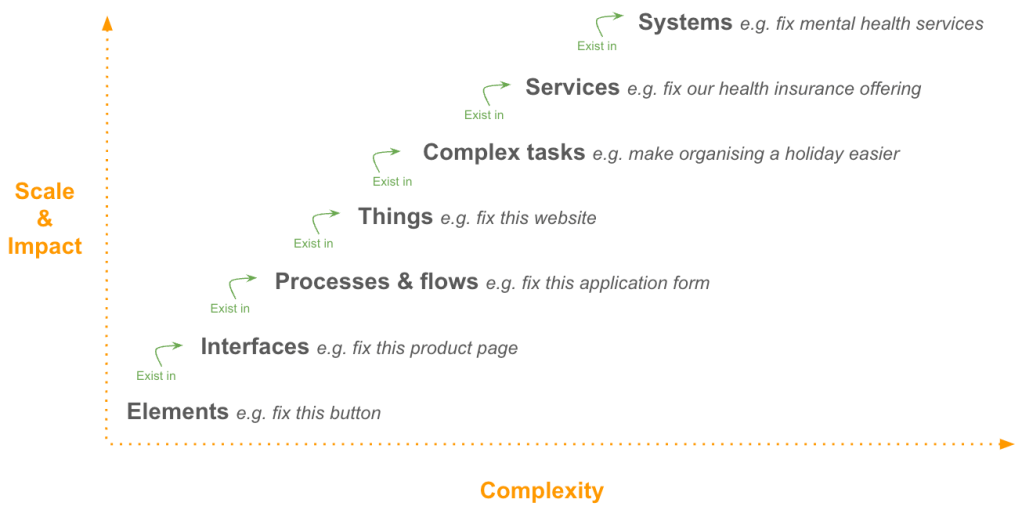
I’m thinking about is as a ‘design hierarchy’ (after discovering ‘ecological hierarchies’ after seeing parallels with hierarchy of complexity within natural systems) and am picturing it like this:
An example of a design hierarchy showing how impact and complexity increases as the nature of what you are designing increases in scale.
Thinking about it in this way this could represent an extension of Brad Frost’s Atomic Design work that uses its own natural metaphor to frame work within its own hierarchy (atoms, molecules, organisms, templates, pages) that sits firmly at the bottom left of this diagram.
I’ve realised that we have been slowly zooming out, shifting our focus from ‘design systems’ to ‘designing systems’.
It’s interesting to note how each level of the hierarchy exists within the one above it. This idea resonated with me after seeing this quote recently from Eliel Saarinen:
“Always design a thing by considering it in its next larger context — a chair in a room, a room in a house, a house in an environment, an environment in a city plan.”
As you move up the design hierarchy, the things you work rapidly increase in complexity, scale and the number of people they impact upon.
The nature of the problems you are working on change exponentially from ‘what’s the most effective label for this button?’ to ‘why aren’t people attending their GP appointments?’ and ‘how can our organisation become more customer focussed?’
As a designer this can be quite daunting, resulting in vertigo induced imposter syndrome and leaving you wondering how the hell you ended up working on this stuff and how to handle the sheer complexity and size of the problems within it!
I’ve found that wherever you are working on this design hierarchy the classic user centred design process still works brilliantly. Whatever you are working on, start with trying to learn as much about the problem as possible from the perspective of the user before you begin to identify, prototype and test potential solutions with them.
In his wonderful book ‘Imagine If‘ Ken Robinson talks about the flaws within the educational system.
He argues that what students need from their education is to become proficient in some core competencies in order to prepare them for the economic, personal, cultural and social challenges they will face in their lives.
The competencies he identifies are curiosity, creativity, communication, collaboration, compassion, composure and citizenship.
Here’s how Ken breaks them down in his book :
Curiosity – the ability to ask questions and explore how the world works
Creativity – the ability to generate new ideas and apply them in practice
Criticism – the ability to analyse information and ideas and to form reasoned arguments and judgements
Communication – the ability to express thoughts and feelings clearly and confidently in a range of media and forms
Collaboration – the ability to work constructively with others
Compassion – the ability to empathise with others and to act accordingly
Composure – the ability to connect with the inner life of feeling and develop a sense of personal harmony and balance
Citizenship – the ability to engage constructively with society and to participate in the processes that sustain it
I’ve often thought about what being a good designer actually means and I think that these competencies would be a brilliant framework to use to help work that out in practice.
When I think about the best people I’ve worked with I realised that it is these things that they’ve been really good at.
As a designer being good at the tools and methods is one thing but if you don’t have these competencies then you’ll struggle.
They aren’t just relevant to designers of course, but feel really useful to help us to recruit people, set objectives and design our own training and development.
I would wholeheartedly recommend Ken’s book, it covers many other fascinating and important subjects such as creativity, positivity, sustainability and systems thinking.
I want to acknowledge something I’ve experienced that definitely feels like a ‘thing’ when conducting research.
I’m thinking about is as a ‘weight of insight’.
Let me explain.
I’ve been doing lots of research recently with people who are living with some sort of mental health issue.
I’ve heard some incredibly harrowing and personal stories about their lived experiences of trying to get support from mental health services.
They’ve shared these altruistically in an effort to ensure that things that have happened to them don’t happen to other people in the future.
As a researcher you act as a messenger, carrying insights between service users and the people who have the power to make things better.
The weight of insight isn’t just about the amount of insights you’ve learned, it’s the pressure of wanting to do them justice, communicating them effectively so that they have the same impact upon your stakeholders as they had on you when you heard them for the first time.
‘Weight’ feels like an overly negative term but it definitely feels like something that you carry and this can come with a cost, particularly when you’re researching emotional topics such as mental health.
Ironically the empathy that makes you a good researcher and helped you to extract the insight in the first place can also be the thing that increases the impact of the insight upon you.
Sharing this weight really helps.
Conducting research in teams ensures that it’s a shared experience that both shares the knowledge and the weight of insights.
Conversations after research sessions to debrief and decompress are also a really simple and beneficial thing you can do that helps.
Another way of reducing this weight is to ensure that your stakeholders watch the research first hand so that they hear the insights from the source.
Remote research has made this easier than ever allowing stakeholders to participate from anywhere using tools they will probably already have access to.
Good safeguarding practices also help to reduce the weight of insight, ensuring that you preempt the impact of what you might learn and how you can protect the people involved.
Over lockdown I had an idea for a book that was all about sharing the tips and tricks that I’ve found useful on UX projects over the years.
Survival skills for UX projects if you like.
It felt really relevant due to the difficulties we were all facing trying to work from home, while home schooling the kids and trying to avoid catching COVID.
I compiled a list of ideas in Miro and forgot all about it until I read a great article in the Guardian that both reminded me that I had created it and prompted me to do something with it!
The final list is not just relevant to UX’ers, I hope that people working in all sorts of professionals will find it useful.
It’s great fun coming up with ideas for new businesses, apps, services etc.
Uber, but for [context] etc..
Many of these ideas are in reality, absolutely awful, and that’s ok as long as you don’t invest lots of time, effort and money trying to make them real.
A good habit to get into is to try and break your ideas as soon as possible by interrogating them with some simple questions like…
What problem does it solve for people?
What evidence do I have that this problem actually exists, is worth solving and that my idea will solve it?
What the cheapest and fastest way that I could find out if my idea actually solves this problem and that people value this problem being solved?
What are am trying to learn from doing this?
How much of my time / effort / money am I willing to invest in pursuing this idea?
Why will people use my idea vs what is already available? How sure am I that I am right?
Why might my idea fail?
What feels like the riskiest assumptions that I have made that underpin the success of the idea?
In a perfect world how will my idea work from the perspective of the people who use it?
What feel like the most important questions that I should ask my potential customers to explore the idea further?
What’s the most logical next thing to do to help me decide to pursue this or not?
So the next time a new idea pops into your head, use these questions to help you to work out which to spend your hard earned money and rare free time on pursuing!

 James Chudley