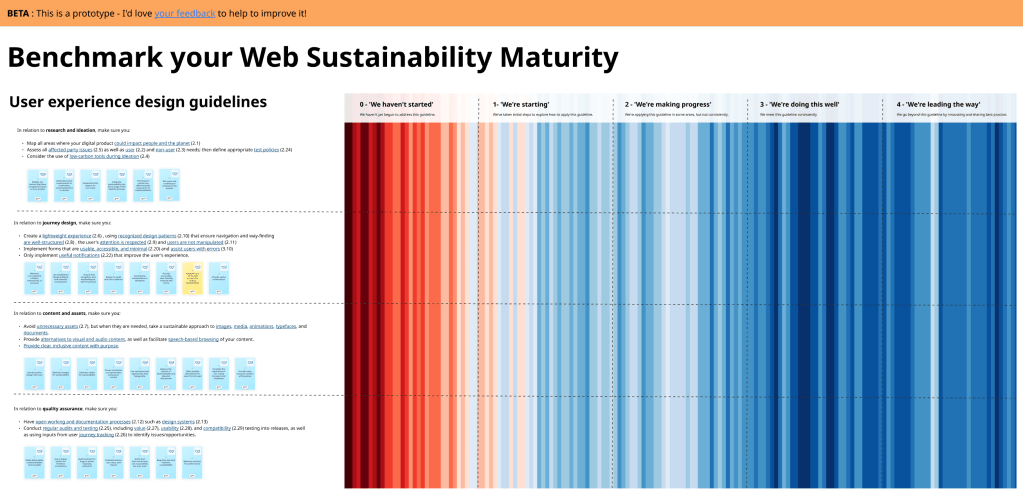
The idea is to evaluate your progress against each of the guidelines as a team to benchmark where you are today and to see where you need to improve.
This is very much a prototype but feels like it’s got legs. Please help yourself to a copy (just duplicate the board), have a play with it and I’d love any feedback to help improve it!
After a recent trip to the ‘More than human’ exhibition at the Design museum I felt inspired to make something.
One particular exhibit, ‘Nature Calendar’ by Marcus Coates really captured my imagination.
His calendar simply lists specific events that happen in the natural world throughout the year in the UK.
I love the idea of having a daily reminder of things that are happening in the natural world, to help shift our thoughts from the everyday, to offer perspective and to remind us of the amazing things that are happening around us.
I thought I’d have a crack at making my own digital version.
It’s been fun (and painful) trying to make it work and fun experimenting with various AI tools to try and bring something to life.
The real joy has been researching the different natural events and discovering the concept of phenology (the study of cyclic and seasonal natural phenomena).
My aim is to convey both what is happening and importantly how the timing of things is changing due to our warming climate.
It’s still a prototype (well isn’t everything) but the 1st September felt like a good day to release it into the world, so here’s ‘NatureNow‘
If you ‘save to home screen’ from your mobile browser (via the share option in your browser) it acts as an app so you can easily check out what is going on every day.
Hopefully it’ll help you to daydream while on the bus, take the edge off that nasty deadline and help you tune into what’s going around you.
For the last year or so I’ve been on a mission to try and reduce the environmental impact of the internet.
Here are some of the resources that I’ve compiled along the way that I’ve found useful and inspiring along with some of my own work that they have all helped shape in some way.
Climate product leaders playbook – 38 nature-positive best practices to enhance your product management skills and contribute to the fight against climate change and biodiversity crises.
I had a great time chatting to Marc on the Service Design Show podcast recently about all things sustainability, service design and decarbonising user journeys.
Given these alarming figures I wonder if the Premier League are prioritising or even aware of the potential carbon footprint of the club websites in relation to their decarbonisation objectives?
Club websites serve huge global fanbases and are typically content heavy, particularly with images and videos which are energy-intensive to store and transfer to users’ devices.
Multiple this usage across the 20 Premier League club websites and the cumulative impact of millions of page loads results in a significant carbon footprint.
So this all got me thinking…
Who would win the Premier League if the winner was the club the smallest website carbon footprint?
I chatted to the folks at Cardamon about the idea and they kindly offered evaluate the websites using their carbon calculator.
To make the results comparable, we calculated the carbon footprint of 10,000 visits to the homepages of each site (clearly the footprint of the entire websites will be significantly higher).**
And the results are in!
The Premier League of website homepage carbon emissions
So hats off to Man City for having the lowest homepage carbon footprint, but let’s face it they’re the best of a bad bunch.
It’s no surprise that Ipswich are anchored to the bottom of the table given their hefty 29 MB homepage.
If the Premier League are serious about meeting their sustainability goals then decarbonising club websites must be a key part of their strategy.
Even a tactical focus on switching them all to green hosting would make a huge difference and feels like a simple tap in.
The benefits of low carbon websites
The benefits of low carbon websites extend far beyond the environment.
Low carbon websites are deliberately designed to be as simple as possible making them easier to use, download faster and available to more people.
Their simplicity means they are more efficient, effective and use less energy – making them better for people, performance, planet and profit.
So what about the carbon footprint of your own website?
How much do you know about the carbon footprint of your websites and what is being done within your organisation to minimise it?
What risk does ignoring your digital carbon footprint pose to your reputation, values or wider sustainability goals?
I’d argue a very significant one.
The climate crisis demands that every responsible organisation should make a plan to minimise the environmental impact of their digital product and services, but many simply don’t know where to start.
I’ve created some simple and practical free tools that will help get the ball rolling:
It’s wonderful to see the Government Digital Service add ‘Minimise Environmental Impact‘ to their design principles for best practice in relation to digital services.
But what exactly should digital professionals do in order to minimise their environmental impact?
To help people get started, I’ve created a ‘Digital Sustainability Strategy’ template (Google doc) that lists a number of activities that will help you reduce both the environmental and societal impacts of your digital services.
Use the template to plan how you will accomplish each of the recommended activities, who will do what and deadlines for when they need to be completed.
It doesn’t cover everything but will to help you get off and running.
This is about progress over perfection after all.
So here’s the plan:
Benchmark your carbon footprint
Switch to a green hosting provider
Offer the best possible user experience
Make everything as simple and lightweight as possible
Focus on doing more good than harm
1. Benchmark your carbon footprint
You need to benchmark your emissions to get a clear idea of how your journey is performing, where the problems are and to help you plan and prioritise your decarbonisation efforts.
I’ve mocked up this simple dashboard to demonstrate how you can visualise this benchmarking data to help you to see how well your user journey is performing and identify where you need to focus your decarbonising efforts.
Your benchmarking results will help you to understand your impact and prioritise your decarbonising efforts
When things are easy to use we spend less time doing them, using less energy as a result.
By ensuring user journeys are useful we can justify the resources we use to create and operate them and by making them accessible we ensure everyone has access to them.
Your objective should be to make your user journey as useful, usable and accessible as possible.
How?
Conduct regular user research on a range of devices to ensure you understand user needs and how and where you need to improve your user journeys.
Aim for people to be able to successfully complete their tasks first time around without wasting time and energy through errors, needing support or spending more time than necessary trying to do what they are trying to do.
Aim to meet the highest level of accessibility compliance possible to ensure the widest possible audience can access and benefit from your service.
Remove anything that is distracting or detracts from people being able to complete their tasks and do everything possible to help them.
Use established design patterns that people will be familiar with and already know how to use.
Always write in plain English and check the average reading age you are writing for (in the UK it’s between 9-11 years old).
4. Make everything as simple and lightweight as possible
Lightweight pages download faster and consume less energy to be stored and transferred across networks. They will work better in areas with poor connectivity and for users with older devices helping to maximise the amount of people who can access your service during challenging circumstances.
Fundamentally people won’t tolerate slow page loading times and if forced to wait will simply go elsewhere.
How?
Reduce – Be ruthless and remove anything (content, pages, scripts, images, features etc.) that isn’t providing any value by questioning the purpose of every element (use these questions to help you).
Replace – Look for alternative ways of communicating the same information using lighter weight alternatives. Be particularly careful with using video and AI given how resource intensive they are.
Optimise – Ensure that assets such as images, videos, fonts, downloads, animations are suitably optimised to minimise their file size.
Think ‘Mobile first’ – Adopt a ‘mobile first’ mindset to help you ensure that people using the smallest screens with poor network connections can still access, use and benefit from your services.
Sustainable services are those that do no harm. We must do better. We should aim to provide regenerative services that do more good than harm and result in a net positive impact on the economy, society and the environment.
Being open about your digital sustainability progress and honest about your successes, failures and plans builds trust and helps your customers to make informed choices about the impact of using your services.
The journey towards regenerative design
How?
Ensure your business models, values and organisational strategic intent is focussed on acting the best interests of people and planet.
Be respectful of people’s time, energy and the effort required of them to use your services.
Ensure people are in full control of their data and are only asked to share the minimum amount of personal information possible.
Ensure no unintended consequences occur as a result of your service.
Don’t use manipulative or deceptive patterns and seek to minimise the time and mental effort required to use your service.
Publish a digital sustainability statement that clearly communicates your impact, the work you’ve done to reduce it and the improvement areas that you will be working on next.
Add a Website Carbon Badge to to automatically calculate and display the carbon emissions of each page or your website.
It has been designed to give you a pragmatic method to help you deliver faster, simpler and more effective user journeys that have less impact on the environment.
I’m over the moon to launch it here and would love to hear your feedback, questions and experiences of using it. 🚀
This presentation tells the story of why we need to urgently decarbonise the internet, the thinking behind the approach and explains how you can start to decarbonise your own user journeys.
It is deliberately simple, jargon free and designed to give digital professions the tools they need to take positive steps to accelerate change.
Please join me in my mission, help spread the word and start decarbonising your user journeys! 💪
The digital industry is responsible for higher global emissions than the aviation industry so it’s imperative that we reduce the our environmental impact.
I’ve created a free ‘Digital Sustainability Checklist’ based on W3C’s ‘Web Sustainability Guidelines’ to help you prioritise, track and report on your digital sustainability efforts.
Knowing where to start with long lists of guidelines can feel overwhelming so I’ve created this checklist to help you:
✅ Prioritise which guidelines to work on : Use the ‘Impact’ vs ‘Effort’ matrix to help you to decide where to concentrate your efforts
✅ Improve your digital sustainability : Track your progress as you design and implement your products and services in more sustainable ways
✅ Evaluate your progress : Evaluate your performance against each guideline to highlight your strengths and weaknesses
Let me know how you get on with it and I’d love to hear your ideas to improve it.